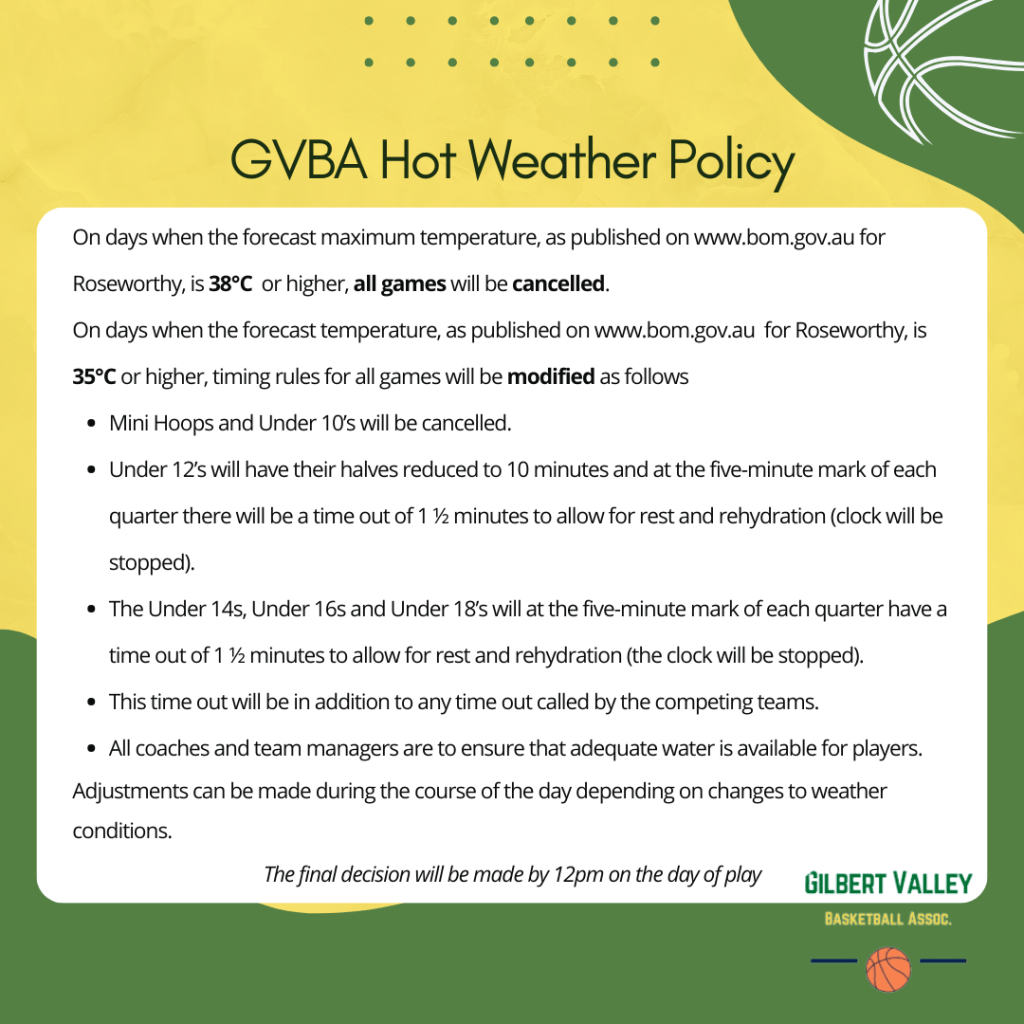
Gilbert Valley Basketball Association follow the SA Country Heat & Extreme Weather Policy, this policy is as follows.
Heat & Extreme Weather Policy
Version 1.0
Ratified by SA Country Council Executive 20/05/2025
Purpose
This policy provides a framework for administrators, players, coaches, officials, and parents/caregivers regarding
activity cancellations or adjustments due to extreme heat or extreme weather conditions.
SA Country Basketball and its affiliated associations are committed to providing a safe, enjoyable environment
for all participants.
Scope
This policy applies to all SA Country Basketball activities including SA Country run trainings, camps, and
tournaments. This is recommended for adoption by affiliated associations.
Definitions
Air-conditioned Stadiums: For the purpose of this policy, airconditioned stadiums are only considered airconditioned if the air conditioning system (evaporative or refrigerated) is installed to the playing area and
effectively reduces the outdoor temperature by a minimum of 5 degrees. For the purpose of this policy, ventilated
stadiums (stadiums equipped with a fan ventilation cooling system) will not be considered air-conditioned
stadiums.
Bureau of Meteorology (www.bom.gov.au): the BoM. For regional activity, the temperature reference used will be
the location of the stadium.
South Australian Country Fire Service: CFS
General Guidelines
- If the forecast maximum temperature (as published at 4:00 PM on BOM (www.bom.gov.au) the day prior
for the nearest town/city) is 38°C or higher, all outdoor training and games will be cancelled, except those
held in air-conditioned indoor stadiums. - Where trainings or games are held early morning or late at night where temperatures are forecast to drop
under 30° games may be resumed at the discretion of the organising body. The organising body will
consider a range of information before deciding it is safe to continue.
Considerations including but not limited to:
o Predicted game time temperature as published on the BoM website for Adelaide (ie. for potential
of a cool change)
o Predicted humidity level
o Actual temperature and humidity levels over preceding days and nights (for potential heat buildup in stadiums or potential increased fatigue of participants)
o Time of day of activity
o Nature of activity
o Temperature readings within stadiums
o Accessibility and effectiveness of air-conditioned facilities - If the actual temperature reaches 35°C or higher, coaches and officials must:
o Provide regular rest and hydration breaks recommendation is officials to call a timeout at or
around the halfway point of each quarter.
o Closely monitor all participants for signs of heat-related illness.
o Ensure adequate water is available.
o Adjust activities based on updated weather conditions.
o Adjustments may be made based on evolving conditions.
o A qualified first aider is recommended to always be present. - When inside venue temperatures reach 38°C all matches, trainings, or activities must be cancelled
immediately.
Game-Day and Training Responsibilities
All Officials, Coaches, and Managers Should: - Take steps to increase airflow and reduce heat buildup in venues.
- Assess conditions before and during games or training sessions.
- Cancel or postpone events if conditions are unsafe.
Coaches and Team Managers Must: - Identify any players with heat-sensitive medical conditions.
- Ensure players are well hydrated.
- Monitor for signs of heat stress and act immediately.
- Rotate players frequently and use timeouts to allow cooling periods.
- Utilise available timeouts or take extra breaks through training
Referees (as directed by organisers) May: - Call additional timeouts recommendation is officials to call a timeout at or around the halfway point of
each quarter. - Extend quarter and half-time breaks.
Extreme Weather Conditions
To prioritise the safety and wellbeing of all participants, the following guidelines will apply in cases of extreme
weather: - Catastrophic Fire Danger Rating
When the Country Fire Service (CFS) declares a Catastrophic Fire Danger Rating for a specific region,
all basketball activities scheduled in the affected area will be cancelled, postponed, or rescheduled. - Bushfire Threat
If there is an immediate bushfire threat in or near the competition or training venue, all games and
activities must be cancelled immediately to ensure the safety of all involved. - Flooding and Access Hazards
In the event of flooding in the region or on surrounding access roads, the safety of travelling
participants must be the primary consideration. Activities should be cancelled or rescheduled if travel
poses any risk.
Local Competitions
Given local variations in scheduling and venue conditions, each affiliated association is encouraged to: - Adopt SA Country’s Policy or;
o Develop and publish their own hot weather policy.
o Use this policy as a template or guide.
o Contact SA Country for assistance with policy development if needed.
Appendix 1: Heat Related Illness and Vulnerability
Signs of Heat Related Illness
It is important to recognise the signs of heat related illness to help prevent the more serious and
potentially life-threatening condition of heat stroke. Signs to watch for include: - Muscle cramps
- Heavy sweating or cessation of sweating
- Cold, pale, moist skin
- Fatigue, weakness, faint/collapse
- Intense thirst
- Nausea, headache
- Confusion, dizziness
- Obvious loss of skill or coordination
- Fast, shallow breathing
Heat Related Illness First Aid - Lay the person down in a cool place and raise legs and hips to improve blood pressure
- Remove excess clothing if appropriate
- Cool the body by applying water and fanning skin (evaporative cooling)
- Apply ice packs to armpits and neck
- Give cool water if conscious
Signs of Heat Stroke
If symptoms of heat stroke develop, continue first aid, and refer the participant for medial
assessment immediately. Signs of heat stroke include: - Nausea, vomiting
- Hot, dry skin or profuse sweating
- Loss of consciousness
- Very high body temperature
- Throbbing headache
- Confusion, difficulty speaking
- Hallucinations, strange behaviour
- Seizures
Vulnerability
Everyone is at risk of heat related illness particularly in periods of hot weather. The combination of
extreme environmental conditions and sustained vigorous exercise is particularly hazardous. The
greater the intensity of the exercise, the greater the risk of heat related symptoms.
Physical characteristics which may increase risk include: - Overweight or unconditioned participants can be at greater risk,
female participants may suffer from heat more than male participants because of the
differences in natural body fat - Endurance fitness/lack of fitness
- Age (the body’s sweating mechanism (cooling mechanism) is poorly developed prior to
puberty, reduced cardiac function in older participants can make it harder to cope) - Medical conditions or medications may predispose a person to heat illness (eg. asthma,
diabetes, virus, flu) - Pregnancy
Listen to your body. No-one is expected to continue activity if they feel distressed or unwell.